Bank Jobs 2026 – Eligibility Criteria and Test Syllabus (Plus Job Interview Tips and Tricks)

Landing a job in the banking sector has always been one of the safest and most respected career choices, and 2026 is shaping up to be no different. Banks continue to hire thousands of candidates every year for roles ranging from clerks and probationary officers to specialist officers and IT staff. But before you can walk into a bank as an employee, you’ll need to clear a written test, meet the eligibility requirements, and — perhaps most importantly — perform well in the interview round.
In this guide, we’ll break down everything you need to know: who is eligible to apply, what the test syllabus looks like, how to prepare effectively, and some practical job interview tips and tricks that can help you stand out from hundreds of other candidates. Whether you’re a fresh graduate or someone switching careers into finance, this article will give you a clear roadmap for 2026.
Why Bank Jobs Are Still a Top Career Choice in 2026
Before diving into the details, it’s worth understanding why banking jobs remain so popular. Job security, structured career growth, attractive perks like housing and medical allowances, and the prestige associated with working in a regulated financial institution all make banking an appealing field. Additionally, banks are increasingly hiring for tech-driven roles — digital banking, cybersecurity, and data analytics — which means the sector isn’t just for finance graduates anymore.
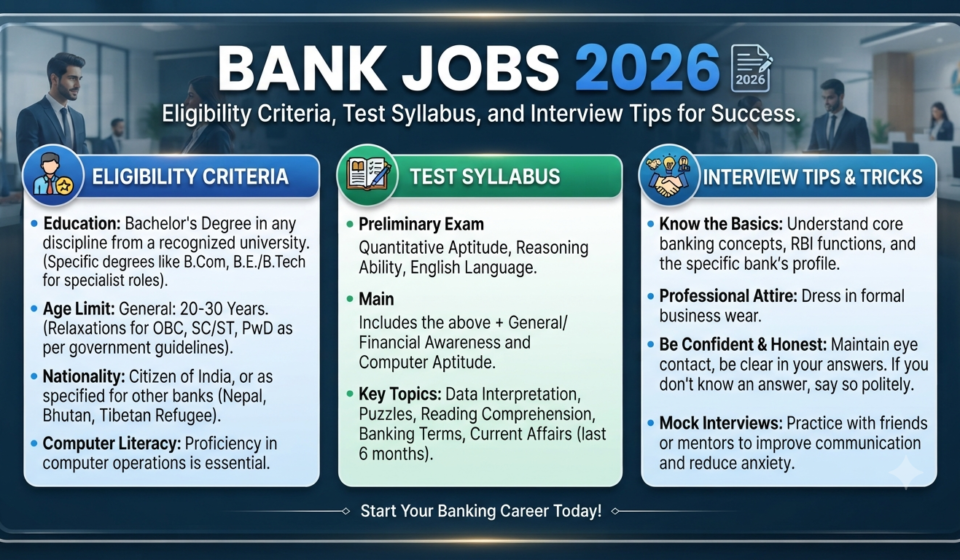
Bank Jobs 2026 – Eligibility Criteria
Every bank has slightly different requirements depending on the position, but most eligibility criteria follow a similar pattern.
Educational Qualification
- Clerical/Teller positions: A bachelor’s degree in any discipline from a recognized university is usually the minimum requirement.
- Officer Grade (Probationary Officer/Management Trainee): A bachelor’s degree is required, though candidates with a master’s degree or professional certifications (like an MBA or a finance-related degree) often have an edge.
- Specialist Officer roles (IT, Law, HR, Marketing): A relevant professional degree or certification in the specific field is mandatory. For example, an IT officer role typically requires a degree in Computer Science or Information Technology.
Age Limit
Most banks set the minimum age at 18 and the maximum age between 28 and 32 years for entry-level positions, though this can vary. Some banks offer age relaxations for candidates from underrepresented groups or those with prior banking experience.
Nationality and Residency
Candidates are generally required to be citizens of the country where the bank operates, and in some cases, a certain period of local residency is required.
Other General Requirements
- A clean background check with no criminal record
- Physical and mental fitness, as certified by a medical examination
- No history of disciplinary action from a previous employer or educational institution
Bank Jobs 2026 – Test Syllabus
Almost all bank recruitment processes involve a multi-stage written test followed by an interview. Here’s a breakdown of the typical syllabus.
1. Quantitative Aptitude
This section tests your numerical and analytical skills. Common topics include:
- Percentages, ratios, and averages
- Profit and loss calculations
- Simple and compound interest
- Data interpretation (tables, graphs, and charts)
- Number series and simplification
2. English Language
Since communication skills are essential in customer-facing banking roles, expect questions on:
- Reading comprehension
- Grammar and sentence correction
- Vocabulary (synonyms, antonyms, fill-in-the-blanks)
- Para jumbles and cloze tests
3. General Awareness / Banking Knowledge
This section usually covers:
- Current affairs (national and international)
- Banking terminology and basic financial concepts
- History and structure of the banking sector
- Recent monetary policy changes and interest rate updates
4. Reasoning Ability
Reasoning questions assess logical thinking and problem-solving skills, including:
- Puzzles and seating arrangements
- Syllogisms
- Blood relations
- Coding-decoding
- Direction sense and series completion
5. Computer Knowledge
Given the shift toward digital banking, many banks now include a section on basic computer literacy:
- MS Office applications
- Internet and email basics
- Computer hardware and software fundamentals
- Cybersecurity awareness
6. Professional Knowledge (for Specialist Officer Roles)
Candidates applying for specialist positions like IT Officer, Legal Officer, or HR Officer are tested on subject-specific knowledge relevant to their field.
How to Prepare for the Bank Job Test
- Get the official syllabus first. Every bank publishes a detailed exam pattern on its recruitment page — always start there rather than relying on generic study guides.
- Create a study schedule. Divide your preparation time across all sections instead of only focusing on your strong areas.
- Practice previous years’ papers. This helps you understand the difficulty level and question patterns.
- Take timed mock tests. Speed and accuracy both matter, since most bank exams have strict time limits.
- Stay updated with current affairs. Read newspapers or banking-focused news apps daily, especially for updates related to monetary policy and the financial sector.
Job Interview Tips and Tricks for Bank Job Aspirants
Clearing the written test is only half the battle. The interview round is where many candidates lose their edge simply because they haven’t prepared enough. Here are some practical job interview tips and tricks to help you perform confidently.
Research the Bank Thoroughly
Before your interview, learn about the bank’s history, mission, recent achievements, and current leadership. Interviewers often ask, “Why do you want to work here?” — a well-researched answer shows genuine interest.
Understand Basic Banking Concepts
Even if you’re applying for a non-technical role, you should be comfortable explaining basic terms like repo rate, NPA (non-performing assets), and the difference between a savings and current account. This demonstrates that you’ve done your homework.
Dress Professionally and Arrive Early
First impressions matter. Business formal attire and arriving at least 15 minutes early shows punctuality and respect for the process.
Practice the STAR Method for Behavioral Questions
When asked about past experiences (teamwork, handling pressure, resolving conflicts), structure your answer using the STAR method: Situation, Task, Action, Result. This keeps your answers focused and easy to follow.
Prepare for Common Banking Interview Questions
Some frequently asked questions include:
- Why do you want to join the banking sector?
- How would you handle an unhappy customer?
- What do you know about our bank’s recent performance?
- Where do you see yourself in five years?
Practicing clear, honest, and concise answers to these questions in advance will help you avoid stumbling during the actual interview.
Ask Thoughtful Questions
At the end of most interviews, you’ll be asked if you have any questions. Avoid saying “no.” Instead, ask something like, “What does success look like in this role during the first six months?” This shows initiative and genuine interest in the position.
Stay Calm Under Pressure
Bank interviews sometimes include stress-testing questions designed to see how you react under pressure. Take a breath, think before answering, and don’t be afraid to pause for a moment before responding.
Common Mistakes to Avoid
- Applying without checking the specific eligibility criteria for the exact position
- Ignoring the official syllabus and relying only on outdated study material
- Skipping mock tests and time management practice
- Walking into the interview without researching the bank
- Giving vague, memorized answers instead of personalized responses
Frequently Asked Questions
Q1: What is the minimum qualification required for bank jobs in 2026? A bachelor’s degree from a recognized university is the minimum requirement for most entry-level bank positions, though specialist roles may require additional certifications or degrees.
Q2: Is there an age limit for applying to bank jobs? Yes, most banks set the age range between 18 and 32 years for entry-level roles, though this can vary by bank and position, and some relaxations may apply.
Q3: What subjects should I focus on most for the bank exam? Quantitative aptitude, reasoning ability, and English language typically carry the most weight, but general banking awareness is equally important for scoring well overall.
Q4: How can I improve my performance in the bank job interview? Research the bank, understand basic banking concepts, practice common interview questions, and use the STAR method to structure your answers to behavioral questions.
Q5: Do all banks have the same syllabus? No, while most banks follow a similar overall pattern (quantitative aptitude, English, reasoning, general awareness), the exact syllabus, weightage, and cut-off marks can vary between institutions, so always check the official notification.