

Waiting for a promotion to “just happen” is one of the biggest career mistakes people make. Many employees believe that showing up on time, completing tasks, and staying loyal to a company is enough to eventually earn a bigger title and a bigger paycheck. But in reality, promotions rarely go to the hardest workers — they go to the most visible, most strategic, and most prepared ones.
If you’ve been putting in long hours, hitting your targets, and still watching colleagues move up the ladder faster than you, the problem usually isn’t effort. It’s approach. Promotion decisions are influenced by perception, relationships, and readiness just as much as performance. The good news is that all of these factors are within your control.
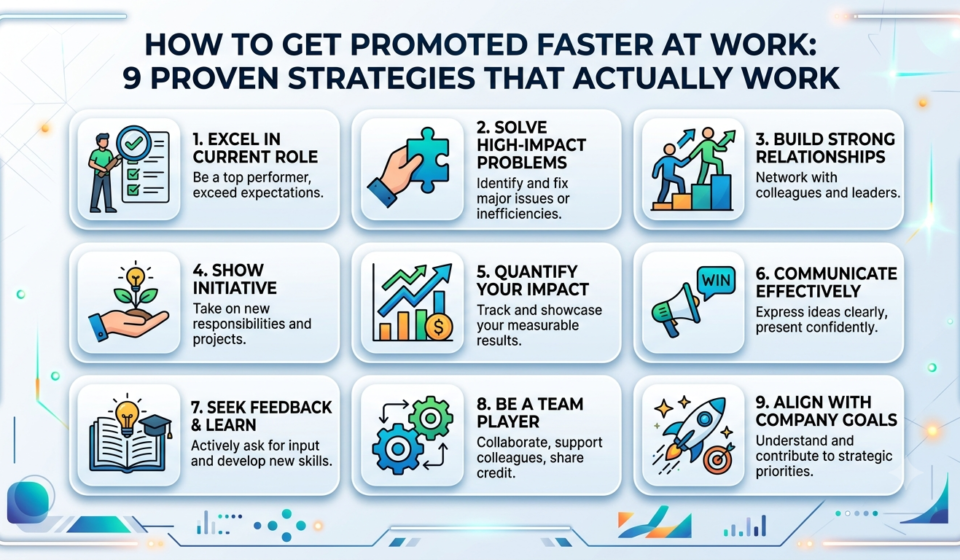
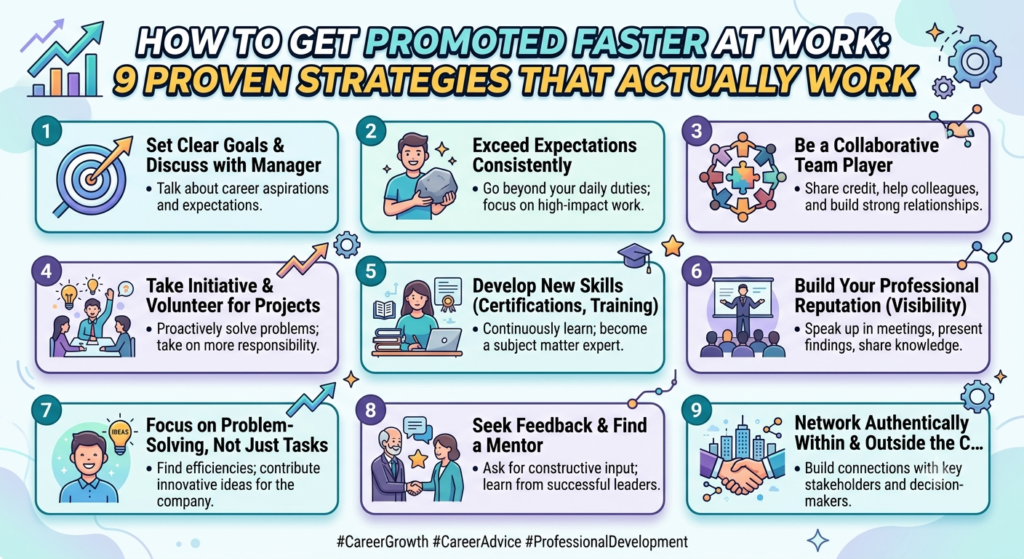
This guide breaks down nine practical, research-backed strategies to help you get promoted faster, whether you’re aiming for your next title in six months or building a long-term path toward leadership.
1. Understand What “Promotion-Ready” Actually Means
Before you can chase a promotion, you need to know exactly what it requires. Too many employees assume that hard work alone will be noticed and rewarded, but promotion criteria are rarely obvious from the outside. Ask your manager directly: “What would it take for me to move into the next role?”
Most employees never ask this question, which means they’re guessing at expectations instead of working toward a clear target. When you get a direct answer — whether it’s specific skills, measurable outcomes, or leadership behaviors — treat that list as your personal roadmap. Revisit it every few months to track your progress and adjust where necessary.
2. Do the Job Before You Have the Title
One of the most overlooked truths about promotions is that managers tend to promote people who are already operating at the next level, not people who simply promise they will once they receive the title. If you want to move into a senior or leadership role, start acting like you’re already there.
This could mean mentoring newer team members, taking ownership of a small project from start to finish, or making decisions that are typically reserved for someone in that higher position. When you consistently perform above your current job description, your promotion starts to feel like a formality rather than a risk for your employer. It shifts the conversation from “should we promote this person” to “we should have promoted this person already.”
3. Make Your Wins Visible
Quiet excellence often goes unnoticed, especially in larger organizations where managers are juggling multiple priorities and team members. It’s not enough to do great work — you also need to ensure that work is seen by the right people.
Keep a running record of your achievements: completed projects, measurable results, positive client or peer feedback, and problems you’ve solved. Share these updates proactively during one-on-one check-ins, team meetings, or performance reviews. Visibility isn’t about bragging — it’s about making sure the people who influence promotion decisions actually have the information they need to advocate for you. If your manager isn’t aware of your contributions, they can’t fight for your advancement in leadership discussions.
4. Build Relationships Beyond Your Immediate Team
Promotions are rarely decided by a single person in a vacuum. In most organizations, they involve input from multiple stakeholders — your direct manager, senior leadership, and sometimes even peers from other departments. This means your reputation needs to extend beyond your immediate circle.
Make an effort to build genuine working relationships across departments. Volunteer for cross-functional projects, attend company-wide events, and contribute meaningfully in meetings outside your usual team. Get to know senior leaders, not through forced networking, but by consistently delivering value in interactions with them. The more people across the organization who can speak positively about your work ethic and capabilities, the stronger your case becomes when promotion discussions happen behind closed doors.
5. Solve Problems Before You’re Asked To
Employees who identify issues and bring solutions — not just complaints — stand out immediately in any organization. Most people are quick to point out what’s broken but slow to propose how to fix it. Be the exception.
Look for inefficiencies, communication gaps, or recurring problems in your team’s workflow, then take the initiative to propose a solution, even if it’s outside your formal responsibilities. This kind of proactive problem-solving signals ownership and strategic thinking, both of which are exactly what leadership roles require. Managers remember the employee who fixed a broken process without being asked far more than the one who simply completed their assigned tasks.
6. Ask for Feedback Regularly — Not Just at Review Time
Don’t wait for an annual performance review to find out where you stand. By the time formal reviews happen, months of potential improvement may have already been lost. Instead, check in with your manager every few weeks with a simple, direct question: “What’s one thing I could be doing better right now?”
Frequent feedback allows you to course-correct in real time, rather than discovering blind spots too late to fix them before the next promotion cycle. It also demonstrates to your manager that you’re actively invested in your own growth, which builds trust and positions you as someone who takes development seriously rather than someone who needs to be managed closely.
7. Communicate Your Career Goals Clearly
Managers cannot advocate for a promotion they don’t know you want. It’s easy to assume that ambition speaks for itself through hard work, but many capable employees get overlooked simply because leadership assumed they were satisfied in their current role.
Have an honest, direct conversation with your manager about your career goals and realistic timeline. Be specific: mention the role or level you’re aiming for and ask what steps would help you get there. This conversation turns your manager into an active participant in your growth rather than someone who only reacts after the fact. It also opens the door to being considered for stretch assignments or projects that align with the next stage of your career.
8. Sharpen the Skills That Matter Most at the Next Level
Technical skill alone rarely earns a promotion, especially as you move into more senior positions. At higher levels, communication, decision-making under pressure, and leadership presence typically matter more than raw technical output.
Invest deliberately in these areas — through formal courses, mentorship from someone already in the role you want, or simply by practicing in your daily work. Volunteer to lead a meeting, present results to stakeholders, or represent your team in a cross-departmental discussion. These small, repeated opportunities build the confidence and visibility needed to be seen as ready for more responsibility.
9. Know When to Push — and When to Move On
Sometimes the fastest path to a promotion isn’t waiting longer at your current company — it’s recognizing when growth has genuinely stalled. Not every organization has room to promote every high performer, regardless of how deserving they are.
If you’ve consistently exceeded expectations, taken on additional responsibility, and had honest conversations about advancement without any real movement over a reasonable period, it may be worth exploring opportunities elsewhere. In many cases, a calculated move to a company that values and rewards your contributions can accelerate your career and salary far faster than staying in a role with no clear path forward. Loyalty matters, but it shouldn’t come at the cost of your long-term growth.
Common Mistakes That Slow Down Promotions
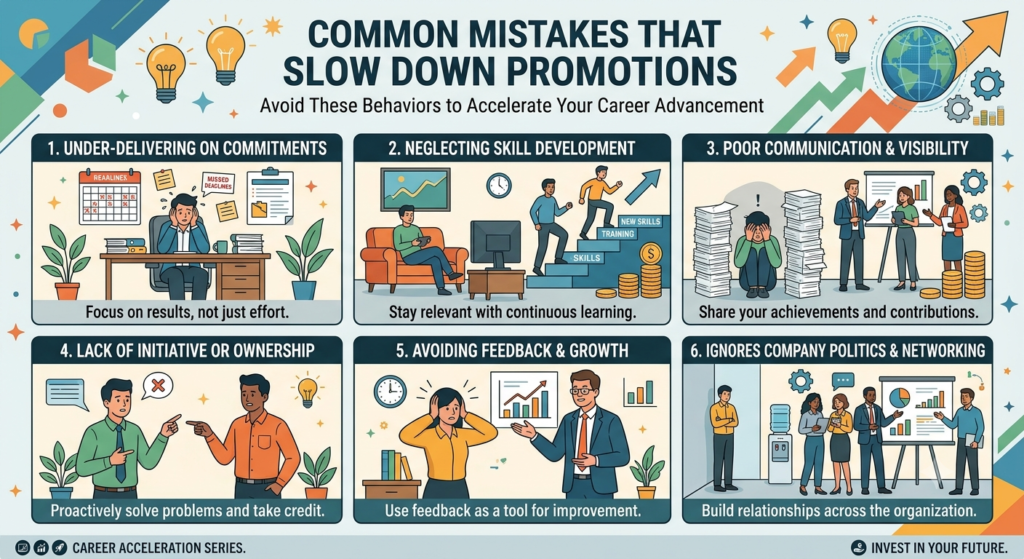
Even talented employees can unintentionally delay their own advancement. Watch out for these common missteps:
- Staying silent about your ambitions and expecting others to notice on their own.
- Focusing only on your own tasks instead of contributing to broader team or company goals.
- Avoiding visibility out of fear of seeming boastful, which often backfires by keeping your contributions invisible.
- Waiting for permission to take on leadership responsibilities instead of demonstrating them proactively.
- Ignoring feedback or treating criticism defensively instead of using it to improve quickly.
Avoiding these patterns can be just as important as adopting the strategies above.
Frequently Asked Questions
How long should I wait before asking for a promotion?
There’s no universal timeline, since it depends on your industry, company size, and role. As a general guideline, if you’ve consistently exceeded expectations for 6 to 12 months and taken on responsibilities beyond your current title, it’s reasonable to start the conversation with your manager rather than waiting indefinitely.
What if my manager keeps saying “not yet” without clear reasons?
Ask for specifics in writing, such as measurable goals or skills you need to demonstrate. If the answer remains vague after multiple conversations, it may signal that the growth path in your current role or company is limited, which is a sign to reassess your options.
Does changing companies really speed up promotions?
In many cases, yes. Moving to a new company allows you to negotiate a title and salary based on your current skill level rather than your history within an organization, which can sometimes accelerate advancement faster than an internal promotion cycle.
Is it okay to directly tell my manager I want a promotion?
Yes. Being direct about your career goals is one of the most effective ways to be considered for advancement. Managers can’t read minds, and clear communication removes ambiguity about your intentions.
Final Thoughts
Getting promoted faster isn’t about luck, and it isn’t only about working harder than everyone else. It’s about positioning yourself as the obvious next choice through consistent performance, visibility, strong relationships, and clear communication about your goals. When you combine doing the job before you have the title with proactive problem-solving and honest conversations with your manager, promotion becomes less about chance and more about timing.
Start with one or two strategies from this list, apply them consistently over the next few months, and track how your visibility and readiness improve. Career growth is rarely instant, but with the right approach, it can absolutely be accelerated.