
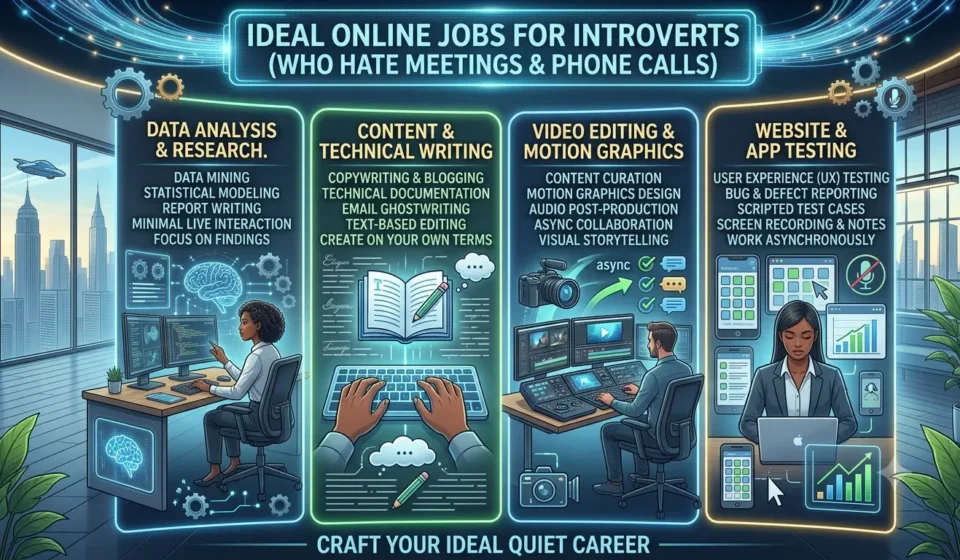

Meta Description: Discover the best online jobs for introverts in 2026 — no meetings, no calls, no small talk. Real roles with strong pay and full async flexibility.
Introduction
If the thought of back-to-back Zoom calls makes your skin crawl, you’re not alone — and you’re not broken. Plenty of highly capable, talented people simply do their best work in quiet, without being interrupted by mandatory check-ins or impromptu “quick chats.”
The good news? The internet has created an entire economy of jobs that are almost entirely text-based, async, and solo-friendly. No cold calls. No all-hands meetings. No small talk in the break room. Just you, your work, and your results.
This guide covers the best online jobs for introverts in 2026 — roles that are genuinely low-contact, pay well, and match the kind of deep, focused work that introverts tend to excel at. We’ll cover what each job involves, what it pays, and how to get started.
Why Online Work Is a Natural Fit for Introverts
Introversion isn’t shyness — it’s about where you get your energy. Most introverts find social interaction draining and solo work energizing. That’s not a weakness. In the right environment, it’s a serious professional advantage.
The problem with traditional office jobs is that they’re designed around extroversion: open offices, group meetings, spontaneous collaboration, and performance reviews based partly on how much you “engage” with the team. Remote and online work strips most of that away.
When you work online — especially in async-first companies — communication happens through written messages, documents, and structured updates. Nobody drops by your desk. Meetings are either rare or optional. You can think through your response before sending it. For introverts, this is the natural habitat.
The roles that follow were specifically chosen because they require minimal live communication. Most involve zero phone calls and few or no scheduled meetings.
Best Online Jobs for Introverts With No Phone Calls
1. Freelance Writer / Content Writer
Pay range: $30,000 – $100,000+/year
Writing is, almost by definition, a solitary act. Freelance writers research, draft, and edit content for blogs, businesses, magazines, and brands — almost entirely through written communication. Client briefs come via email or a shared doc. Revisions happen asynchronously. Most writers go entire weeks without a single live call.
Content writing is one of the most accessible entry points for introverts. You don’t need a journalism degree — you need to write clearly, meet deadlines, and understand what the reader needs. Specializing in a niche (tech, finance, health, SaaS) helps you charge significantly more.
Where to find work: Contently, ProBlogger Job Board, Superpath Slack community, direct cold pitching to brands
2. Copyeditor / Proofreader
Pay range: $35,000 – $75,000/year
If you’re the person who notices the misplaced apostrophe on a menu, copyediting might be your calling. Editors review written content for grammar, clarity, tone, and consistency. The work is meticulous, detail-oriented, and almost entirely text-based. No calls required.
Many editors work with publishing houses, content agencies, or directly with authors. Tools like Google Docs, Track Changes in Word, and editorial style guides (Chicago, AP, APA) are the daily toolkit. It’s quiet, precise work — ideal for introverts who love language.
Where to find work: Reedsy, Editorial Freelancers Association, LinkedIn, Upwork
3. Graphic Designer
Pay range: $50,000 – $110,000/year
Graphic design is a visual, solo craft. Designers work in tools like Adobe Illustrator, Photoshop, Figma, or Canva to create logos, layouts, social media visuals, and branded materials. While there’s occasional client feedback, most of it happens through written briefs and asynchronous revision rounds — rarely a phone call.
Freelance designers especially enjoy high autonomy. You set your hours, pick your clients, and communicate on your schedule. Building a strong portfolio is the most important step to landing well-paid design work.
Where to find work: 99designs, Dribbble, Behance, Contra
4. Web Developer / Front-End Developer
Pay range: $70,000 – $160,000/year
Development is one of the most introverted-friendly tech careers available. Developers spend the majority of their time writing code, debugging, and building — not talking. Most remote developer roles at async-first companies communicate entirely through GitHub issues, Slack messages, and written documentation.
Front-end development (HTML, CSS, JavaScript) is the most accessible starting point. Full-stack and back-end development require more learning but pay considerably more. Bootcamps, freeCodeCamp, and platforms like The Odin Project offer solid self-paced learning paths.
Where to find work: GitHub Jobs, Toptal, arc.dev, Lemon.io
5. SEO Specialist
Pay range: $50,000 – $110,000/year
Search engine optimization is a deeply analytical, largely solo discipline. SEO specialists research keywords, audit websites, analyze traffic data, and develop strategies to improve search rankings. Most of the work is independent — pulling data, writing recommendations, optimizing pages — and communication is usually via reports or Slack.
It’s a field where the results speak for themselves, which suits introverts well. No need to sell yourself in a meeting when the traffic numbers do the talking.
Tools to know: Ahrefs, SEMrush, Google Search Console, Screaming Frog
Where to find work: Remote.co, We Work Remotely, direct agency outreach
6. Data Entry / Data Analyst
Pay range: $35,000 – $90,000/year
Data entry is the most accessible no-contact online job — it requires attention to detail, accuracy, and reliability more than any particular technical skill. Analysts who work with data in Excel, SQL, or Python earn significantly more and still spend most of their time in independent, focused work.
Data roles are structured around output: you either cleaned the dataset or you didn’t. That objectivity removes the social performance element entirely, which many introverts find deeply refreshing.
Where to find work: Clickworker, Appen, Upwork (for analyst roles), LinkedIn
7. Video Editor
Pay range: $45,000 – $90,000/year
YouTube channels, course creators, podcasters, and social media brands all need video editors — and nearly all of this work happens asynchronously. A client sends raw footage; you edit and return the finished product. Communication is primarily through shared project folders and written notes.
Skilled editors who understand pacing, color grading, and storytelling can charge premium rates. Adobe Premiere Pro and DaVinci Resolve are the industry standards worth learning.
Where to find work: Upwork, ProductionHUB, direct outreach to YouTubers, Belay
8. Translator / Transcriptionist
Pay range: $30,000 – $75,000/year
If you’re bilingual or have strong listening skills, translation and transcription offer quiet, focused online work with zero client calls. Translators convert written content between languages. Transcriptionists convert audio to text. Both are solo, output-based, and entirely asynchronous.
Rare language pairs (English-Japanese, English-Arabic, etc.) command significantly higher rates than common combinations.
Where to find work: Rev, TranscribeMe, Gengo, ProZ (for translators)
9. Software Tester / QA Analyst
Pay range: $55,000 – $100,000/year
Quality assurance testers methodically break software — finding bugs, verifying features, and documenting issues. It’s patient, detail-focused work that suits introverted personalities well. Communication is structured: bug tickets, test reports, written documentation. Rarely a live meeting.
Many QA roles are fully remote and async, especially at software companies with global teams.
Where to find work: Testbirds, uTest, LinkedIn, We Work Remotely
10. Online Course Creator / Instructional Designer
Pay range: $50,000 – $150,000+/year (passive potential)
If you have expertise in a subject — coding, photography, marketing, finance, cooking — you can package it into an online course and earn from it repeatedly. Course creation is deeply solo work: outlining, scripting, recording, and editing. Once live, it earns without additional interaction.
Platforms like Teachable, Gumroad, and Udemy handle the sales side. You build it once and it works for years.
Skills That Help Introverts Thrive in Online Work
You don’t need to become a different person to succeed remotely. But a few skills make the difference between scraping by and building a strong online career.
Written communication. Since most async work happens through text, being clear and precise in writing is essential. Practice concise emails, structured project updates, and well-organized documents.
Self-management. Without a manager looking over your shoulder, you need to set your own deadlines, manage your energy, and stay consistent. Time-blocking and simple task management tools (Notion, Todoist, Trello) help enormously.
Niche expertise. The more specialized you become, the less you compete on price and the more clients seek you out. Pick a lane and go deep.
Portfolio building. For creative and technical roles, your portfolio does the selling that a charming personality might do in person. Invest time in making your work visible online.
How to Find Legit Online Jobs With No Phone Calls Required
Not every remote job is truly low-contact. Here’s how to identify the right opportunities before you apply.
Read the job description carefully. Look for phrases like “async-first,” “written communication preferred,” “remote team,” and “flexible hours.” Avoid listings that emphasize “strong phone presence” or “customer-facing.”
Check the company culture page. Many async-friendly companies (Basecamp, Automattic, GitLab, Doist) publish their remote work philosophy publicly. These are your people.
Use async-friendly job boards. Remote.co, We Work Remotely, Himalayas.app, and Working Nomads tend to list roles at companies that have genuinely built their culture around remote, async work — not just remote-tolerant positions.
Ask during the hiring process. Before accepting any offer, it’s fair to ask: “What does a typical workday look like in terms of meetings?” A company that balks at this question is telling you something important.
FAQ: Online Jobs for Introverts
Q: What is the best online job for someone who hates talking on the phone? The best no-phone online jobs include freelance writing, graphic design, web development, video editing, SEO, and data analysis. All of these roles are primarily text-based and asynchronous, with little to no live communication required.
Q: Can introverts be successful working online? Absolutely — and often more so than in office settings. Online work tends to reward output and expertise over social performance. Introverts who do deep, focused work often outperform in remote environments where results matter more than visibility.
Q: Do remote online jobs really have no meetings at all? Truly zero-meeting jobs are rare, but many roles have very few — sometimes just one brief weekly check-in via text or a written status update. Freelancers and solo contractors often have the most control, with client communication almost entirely through email or messaging apps.
Q: What online jobs for introverts pay the most? The highest-paying online roles for introverts tend to be in tech: software development, cloud architecture, machine learning engineering, and data science. Outside of tech, UX/UI design, SEO consulting, and course creation also offer strong earning potential with minimal social interaction.
Q: Is freelancing better than a remote job for introverts? Both have advantages. Freelancing offers maximum autonomy — you choose your clients, your hours, and how you communicate. Remote employment offers more stability and benefits. Many introverts start freelancing and later transition to a remote role, or vice versa, depending on what suits their lifestyle.
Conclusion
Being an introvert isn’t a career liability — in the online world, it’s an asset. The ability to focus deeply, communicate precisely in writing, and work independently without constant validation is exactly what many of the best remote jobs require.
You don’t have to pretend to enjoy meetings you dread or build a career around skills that drain you. There’s an entire job market designed — whether intentionally or not — around the way introverts work best.
Your next step: Pick one role from this list that matches your existing interests or skills. Spend 30 days learning one specific tool or building one portfolio piece in that niche. You don’t need to overhaul your life — just take one quiet, focused step in the right direction.
The best online job for you is out there. And the interview might just be an email.
Internal linking opportunities:
Read more