Description: AI and jobs are reshaping the workplace fast. Discover how AI is changing the job market and practical steps to stay relevant in 2026 and beyond.

How AI Is Changing the Job Market (And How to Stay Relevant)
A few years ago, the idea of a computer writing marketing copy, analyzing legal contracts, or diagnosing illnesses sounded like science fiction. Today, it’s just Tuesday. AI and jobs are now talked about in the same breath everywhere — from boardrooms to dinner tables to late-night doom-scrolling sessions — and for good reason. The way we work is shifting faster than at any point since the internet itself reshaped the economy.
If you’ve felt a flicker of anxiety wondering whether your job is “AI-proof,” you’re not alone. But here’s the reassuring part: this isn’t the first time technology has disrupted work, and history shows that the people who adapt early tend to come out ahead. In this article, we’ll break down exactly how AI is changing the job market, which roles are most affected, what new opportunities are emerging, and — most importantly — practical steps you can take starting today to stay relevant no matter what industry you’re in.
How AI Is Reshaping the Job Market Right Now
AI isn’t a distant future concern anymore; it’s already embedded in everyday work. Companies are using AI tools to screen resumes, generate reports, write code, manage customer service chats, and even assist in hiring decisions. According to recent labor market research, a significant share of jobs now involve at least some tasks that can be automated or augmented by AI tools.
This doesn’t mean robots are simply replacing humans on a one-to-one basis. In most cases, AI is changing how jobs are done rather than eliminating them outright. A graphic designer might now use AI to generate initial concepts, then spend more time refining and personalizing the final product. A customer support agent might rely on AI chatbots to handle routine questions, freeing them up to manage more complex customer issues.
The Shift From Routine Tasks to Judgment-Based Work
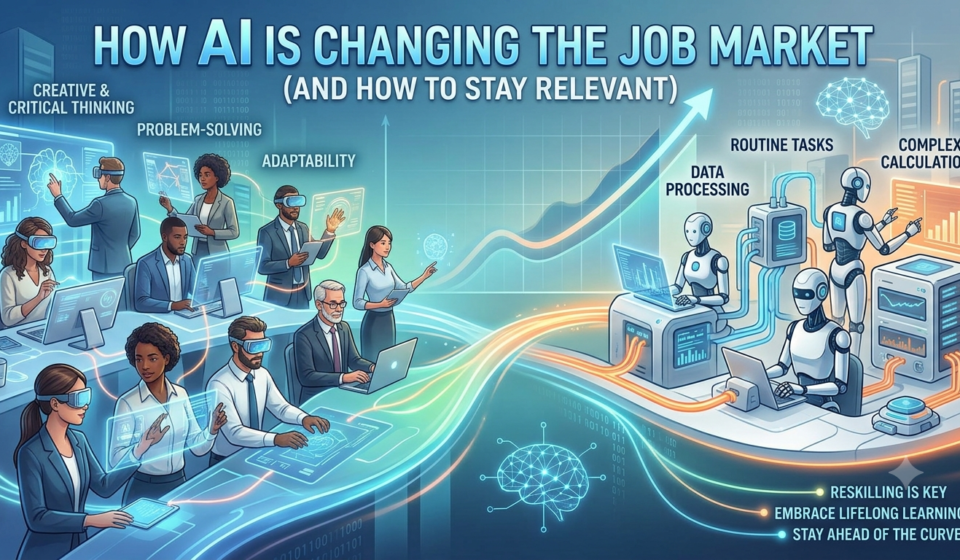
One clear pattern is emerging: AI is best at handling repetitive, predictable tasks — and humans are increasingly valued for judgment, creativity, empathy, and complex decision-making. Jobs built almost entirely around routine data entry, basic transcription, or simple scheduling are seeing the heaviest automation pressure. Meanwhile, roles that require emotional intelligence, strategic thinking, or hands-on physical skill are proving much harder to replace.
Which Jobs Are Most Affected by AI?
Not all jobs are impacted equally. Understanding where you sit on this spectrum can help you plan your next move.
Jobs at Higher Risk of Disruption
Roles that involve highly repetitive, rules-based tasks tend to be the most exposed, including:
- Data entry and basic administrative support
- Routine bookkeeping and simple accounting tasks
- Basic copywriting and content summarization
- Telemarketing and entry-level customer service
- Simple translation and transcription work
This doesn’t mean these jobs will vanish overnight, but the day-to-day responsibilities within them are already changing, often requiring workers to oversee AI tools rather than perform every task manually.
Jobs Being Augmented Rather Than Replaced
Many professions are being enhanced by AI instead of eliminated:
- Healthcare professionals use AI for diagnostics support, but human judgment, patient care, and ethical decision-making remain irreplaceable.
- Teachers use AI to create lesson plans faster, but mentorship and classroom management still require a human touch.
- Marketers use AI for content drafts and data analysis, while strategy and brand voice still rely on human creativity.
- Software developers use AI coding assistants to speed up work, but architecture decisions and debugging complex systems still need skilled engineers.
New Jobs Created by AI
Just as the internet created entirely new careers like social media managers and app developers, AI is generating fresh job categories:
- AI prompt engineers and AI trainers
- AI ethics and compliance specialists
- Machine learning operations (MLOps) engineers
- AI-assisted content editors and quality reviewers
- Data privacy and AI governance consultants
Industries Experiencing the Biggest AI-Driven Changes
Technology and Software Development
AI coding assistants have become standard tools in many development teams, speeding up routine coding tasks. This has shifted demand toward developers who can think strategically, solve complex problems, and integrate AI tools effectively rather than those who only write basic code.
Customer Service and Support
AI chatbots now handle a large share of routine customer inquiries. Human agents increasingly focus on escalated issues, relationship management, and situations requiring empathy and nuanced problem-solving.
Marketing and Content Creation
AI tools can draft blog posts, social media captions, and ad copy in seconds. This has lowered the barrier to producing content at scale, but it has also increased demand for skilled editors, strategists, and storytellers who can add a genuine human perspective that AI cannot replicate.
Healthcare
AI assists with image analysis, administrative paperwork, and preliminary diagnostics, allowing healthcare workers to spend more time on direct patient care — a shift many professionals in the field actually welcome.
Finance and Accounting
Routine bookkeeping, fraud detection, and basic financial reporting are increasingly automated, while roles focused on financial strategy, advisory services, and complex compliance work remain firmly human-led.
How to Stay Relevant in an AI-Driven Job Market
This is the part that matters most: what can you actually do about it? Here are concrete, actionable steps.
1. Build AI Literacy, Even If You’re Not in Tech
You don’t need to become a programmer, but understanding how to use common AI tools relevant to your field is quickly becoming as essential as knowing how to use email or spreadsheets. Spend a few hours experimenting with AI tools used in your industry, whether that’s AI writing assistants, data analysis tools, or design generators.
2. Double Down on Uniquely Human Skills
Skills like critical thinking, emotional intelligence, leadership, negotiation, and creative problem-solving are difficult for AI to replicate. Employers consistently rank these as top priorities precisely because they’re becoming more valuable as automation handles routine tasks.
3. Focus on Continuous Learning
The half-life of technical skills is shrinking. Set a habit of learning something new every quarter, whether through online courses, industry certifications, or simply following credible voices in your field. Treat learning as an ongoing part of your job, not a one-time event before graduation.
4. Specialize in Areas AI Struggles With
Hands-on trades, complex interpersonal work, creative direction, strategic planning, and roles requiring deep contextual judgment remain harder to automate. If your role overlaps heavily with these areas, lean into them and make them visible on your resume and LinkedIn profile.
5. Learn to Work With AI, Not Against It
The most resilient professionals aren’t the ones competing with AI — they’re the ones using it as a force multiplier. Someone who can use AI tools to produce better, faster work than peers who avoid them will consistently have an edge, regardless of industry.
6. Strengthen Your Professional Network
Opportunities increasingly come through relationships and referrals rather than cold applications, especially as AI-screened applications make traditional job searching more competitive. Stay active on LinkedIn, attend industry events, and maintain genuine professional relationships.
7. Audit Your Skills Against Job Market Trends
Regularly compare your current skill set against job postings in your field. Look specifically at which skills are newly appearing in listings versus disappearing — this is one of the clearest real-time signals of where the market is heading.
Frequently Asked Questions
Will AI take over most jobs in the next decade? Most labor market research suggests AI will transform far more jobs than it eliminates outright, shifting day-to-day tasks rather than wiping out entire professions. Jobs heavy in repetitive, predictable tasks face the most disruption, while roles requiring judgment, creativity, and human connection are expected to remain in demand.
What jobs are safest from AI automation? Roles requiring complex interpersonal skills, hands-on physical work, creative strategy, and high-stakes decision-making — such as therapists, skilled tradespeople, executive leaders, and creative directors — tend to be more resistant to automation.
Do I need to learn coding to stay relevant in an AI job market? Not necessarily. While technical literacy helps, the more universally valuable skill is learning how to effectively use AI tools relevant to your specific industry, paired with strong critical thinking and communication skills.
How can I tell if my job is at risk from AI? Look at how much of your role involves repetitive, rules-based tasks versus judgment calls, creativity, or relationship management. The more your job leans toward the latter, the more resilient it tends to be.
Is it too late to start adapting to AI in my career? No. The job market is still in the early-to-middle stages of this shift, and most employers value workers who show initiative in learning new tools, regardless of when they start.
Final Thoughts: Adapting Is the New Job Security
AI and jobs will keep evolving together, and trying to predict every detail of that future is less useful than simply preparing to adapt. The professionals who thrive won’t necessarily be the most technical people in the room — they’ll be the ones who stay curious, keep learning, and find ways to combine human strengths with AI capabilities.
If you’re feeling uncertain about where you stand, start small: pick one AI tool relevant to your field, spend an hour learning it this week, and pay attention to how it changes your workflow. That single step puts you ahead of a large share of the workforce that hasn’t started yet.