

Introduction
/jobs /upload-cv /blog
You work hard every day. You show up on time, deliver results, and support your team — yet somehow, that promotion still feels out of reach. Sound familiar?
Career growth in the UK job market has never been more competitive. With industries evolving rapidly, artificial intelligence reshaping roles, and employers raising the bar on expectations, simply doing your job well is no longer enough to move ahead.
The good news? Career advancement is a skill — and like any skill, it can be learned.
In this guide, you’ll discover 10 actionable career growth tips that are helping UK professionals land promotions, increase their salaries, and build careers they’re genuinely proud of. Whether you’re just starting out or you’ve been in your field for a decade, these strategies will give you a clear roadmap to move forward.
What Is Career Growth and Why Does It Matter?
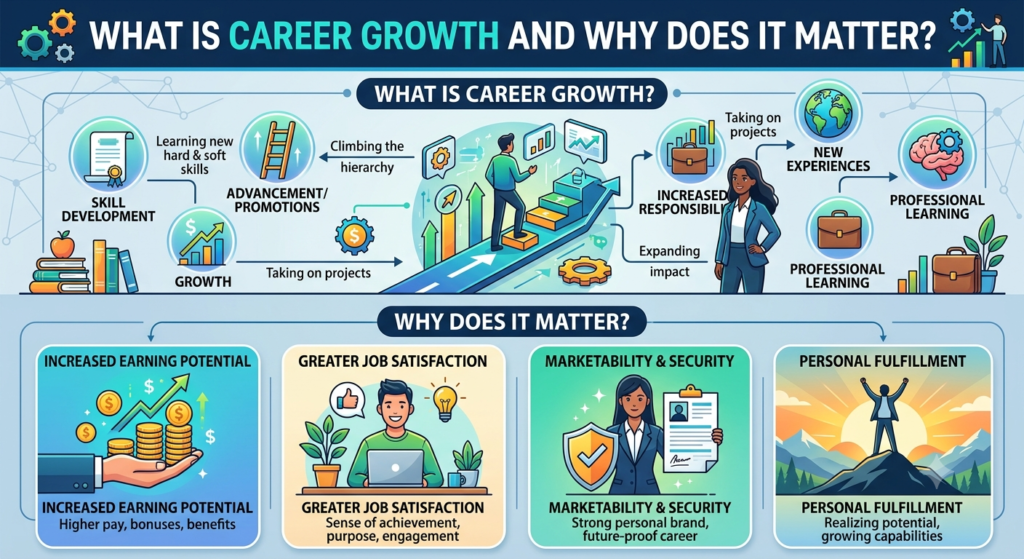
Before we dive in, let’s be clear about what career growth actually means. It’s not just about climbing the corporate ladder or chasing a bigger pay cheque. Career growth is the ongoing process of developing your skills, expanding your responsibilities, building meaningful relationships, and moving intentionally toward your professional goals.
In the UK, where workplace culture, employee wellbeing, and professional development are increasingly valued by top employers, investing in your career growth pays dividends — not just financially, but in job satisfaction, confidence, and long-term security.
Now, let’s get into the strategies.
1. Set SMART Career Goals That Actually Work
One of the most common reasons UK professionals feel stuck is a lack of clear direction. Without defined goals, you’re reacting to opportunities rather than creating them.
How to Set Career Goals the Right Way
Use the SMART framework:
- Specific — “I want to become a Senior Project Manager” not “I want a better job”
- Measurable — “within 18 months”
- Achievable — based on your current skills and experience
- Relevant — aligned with your values and industry
- Time-bound — with a clear deadline to stay accountable
Write your goals down and review them monthly. Research consistently shows that people who write their goals are significantly more likely to achieve them than those who keep goals only in their heads.
Internal link opportunity: See our guide on How to Write a Career Development Plan
2. Invest in Continuous Learning and Upskilling
The UK job market is evolving fast. Roles that didn’t exist five years ago are now among the most in-demand — and roles that seem secure today may look very different by 2030. The professionals who thrive are those who make learning a non-negotiable habit.
Best Ways to Upskill in the UK
- Online courses: Platforms like Coursera, FutureLearn (a UK-based platform), LinkedIn Learning, and Udemy offer flexible, affordable courses across all industries
- Professional qualifications: Consider industry-recognised certifications such as PRINCE2 (project management), ACCA (finance), CIM (marketing), or CIPD (HR)
- Apprenticeships and degree apprenticeships: Available to adults of all ages in the UK, not just school leavers
- Employer-funded training: Many UK employers offer training budgets — ask your manager if you haven’t already
Aim to dedicate at least 30 minutes per day to professional development. That’s just 3.5 hours per week — a small investment with a significant long-term return.
3. Build a Professional Network That Opens Doors
Here’s a fact that surprises many people: a large share of UK job vacancies are never publicly advertised. They’re filled through referrals, professional networks, and word of mouth. If you’re only applying to jobs on boards, you’re missing a huge portion of the market.
How to Network Effectively in the UK
- LinkedIn: Update your profile, share insights, comment on posts, and connect with people in your field. The UK has one of the most active LinkedIn communities in Europe
- Industry events: Look for networking events, conferences, and seminars through platforms like Eventbrite, Meetup, or your professional association
- Alumni networks: Your university alumni community is an underused goldmine of connections
- Local business groups: Chambers of commerce and local business networks are excellent for building connections in your area
The key to good networking is giving before you receive. Share useful content, make introductions, and offer your expertise. Relationships built on genuine value are far more powerful than transactional connections.
4. Find a Mentor to Accelerate Your Growth
A mentor is someone who has already walked the path you’re on and is willing to guide you along the way. Having the right mentor can compress years of learning into months — and open professional doors you didn’t know existed.
How to Find a Mentor in the UK
- Within your organisation: Many UK companies have formal mentoring programmes — speak to your HR department
- Professional associations: Bodies like the CMI (Chartered Management Institute), CBI, or your industry-specific association often run mentoring schemes
- LinkedIn outreach: A thoughtful, personalised message to someone you admire can go a long way
- Formal programmes: Platforms like The Mentor Me Foundation and Step Forward Mentoring connect professionals across the UK
When approaching a potential mentor, be specific about what you’re hoping to learn and why you’ve chosen them. Nobody wants to mentor someone who hasn’t done their homework.
5. Take Ownership and Show Initiative
Managers promote people they trust. And trust is built through one thing above all else: ownership.
Taking ownership means going beyond your job description. It means identifying problems and proposing solutions, following through on commitments without being chased, and treating every task — no matter how small — as if it matters. Because it does.
Practical Ways to Show Initiative
- Volunteer for projects outside your usual responsibilities
- Identify inefficiencies in your team and suggest improvements
- Present a new idea in your next team meeting
- Follow up on tasks proactively rather than waiting to be asked
In UK workplaces, employees who demonstrate initiative are consistently rated more promotable by their managers. It signals leadership potential — one of the most valued qualities in any organisation.
6. Develop a Strong Personal Brand
Your personal brand is the professional reputation you build over time — both inside and outside your organisation. In a world where recruiters Google candidates before interviews and managers research internal staff before promotions, your brand matters more than ever.
How to Build Your Personal Brand in the UK
- Polish your LinkedIn profile: Use a professional photo, write a compelling headline, and fill your profile with specific achievements rather than generic duties
- Share your expertise: Write articles, post insights, or comment thoughtfully on industry discussions
- Be consistent: Show up reliably, communicate clearly, and deliver what you promise
- Speak up: Contribute in meetings, volunteer to present, and make sure your voice is heard
You don’t need thousands of followers to have a strong personal brand. Being known as the most knowledgeable, reliable, or innovative person in your niche is worth far more.
7. Master Communication Skills — The Career Multiplier
Technical skills may get you hired, but communication skills get you promoted. This is consistently one of the top findings in UK workplace surveys — employers say communication is the skill they value most and find hardest to hire for.
Key Communication Skills to Develop
- Written communication: Clear, concise emails, reports, and proposals
- Verbal communication: Confident contributions in meetings and presentations
- Active listening: Truly understanding what colleagues and clients need
- Upward communication: Articulating your value and ideas to senior stakeholders
- Negotiation: Making the case for your salary, resources, or ideas
Consider joining a public speaking group like Toastmasters, which has dozens of chapters across the UK, to sharpen your verbal communication skills in a supportive environment.
8. Request Feedback — Then Act on It
Most professionals wait passively for annual appraisals to learn how they’re performing. High performers don’t wait. They actively seek feedback throughout the year and use it to improve continuously.
How to Ask for Feedback Effectively
- Be specific: “What’s one thing I could do better when presenting to clients?”
- Ask regularly, not just at review time
- Seek feedback from peers, not just managers — 360-degree input is far more valuable
- Thank people genuinely when they offer honest criticism
- Most importantly: act on it — nothing destroys trust faster than ignored feedback
In UK workplace culture, managers deeply respect employees who actively seek to improve. It demonstrates self-awareness and a growth mindset — two qualities that predict long-term career success.
9. Understand How Promotions Actually Work in the UK
Many professionals assume promotions are automatic rewards for good performance. They’re not. Promotions are business decisions — and understanding how they’re made gives you a significant advantage.
What UK Employers Look for Before Promoting Someone
- Demonstrated readiness: Are you already performing at the next level before being given the title?
- Business impact: Can you clearly articulate the value you’ve added in measurable terms?
- Leadership potential: Do colleagues trust and look to you for guidance?
- Cultural fit at the next level: Do your communication style and mindset match senior expectations?
Start performing at the level above your current role before asking for a promotion. When the conversation happens, you’ll have evidence — not just ambition.
Internal link opportunity: Read: How to Ask for a Promotion (UK Guide)
10. Prioritise Wellbeing for Sustainable Career Growth
This might be the most underestimated career growth tip of all. Burnout is one of the leading causes of career stagnation in the UK — and it’s entirely preventable.
The most successful professionals don’t work the most hours. They work the most effectively — and that requires protecting their energy.
Practical Wellbeing Tips for UK Professionals
- Use your full annual leave entitlement — the UK average is 28 days, yet millions of workers leave days unused every year
- Set boundaries around work emails outside office hours
- Exercise regularly — even a 20-minute walk improves focus and mood significantly
- Invest in relationships and hobbies outside work
- Seek support early if you’re struggling — many UK employers now offer Employee Assistance Programmes (EAPs)
Career growth is a marathon, not a sprint. Sustainable habits built over years will always outperform intense short-term bursts followed by burnout.
FAQ: Career Growth Tips in the UK
Q1. How long does it take to get promoted in the UK?
The average time between promotions in the UK varies by industry, but most professionals can expect to wait 2–4 years in a role before being considered for advancement. However, by actively applying the strategies in this guide, many professionals accelerate that timeline significantly.Job Brothers & Co., Limited,
Q2. What are the most in-demand skills for career growth in the UK right now?
According to recent UK labour market data, the most sought-after skills include data literacy, AI and digital skills, project management, communication, and leadership. Combining technical expertise with strong soft skills gives you a clear competitive edge.
Q3. Is networking really important for career growth in the UK?
Absolutely. Research consistently shows that professional networking plays a major role in career advancement in the UK — particularly for senior roles. Many positions are filled before they’re ever advertised publicly. Building genuine relationships in your field is one of the highest-return investments you can make in your career.
Q4. How do I ask for a pay rise in the UK?
Timing, evidence, and preparation are everything. Research market rates using resources like Glassdoor, Totaljobs, or the ONS Annual Survey of Hours and Earnings. Prepare a clear case based on your specific contributions and achievements — not just tenure. Request a formal meeting with your manager and approach the conversation collaboratively, not confrontationally.
Q5. What should I do if I feel stuck in my career?
Feeling stuck is common — and it’s usually a signal that something needs to change. Start by identifying whether the issue is skill gaps, lack of visibility, wrong role fit, or an unsupportive environment. Then take one concrete action: speak to a mentor, enrol in a course, update your CV, or have an honest conversation with your manager. Momentum builds from small steps.
Conclusion: Your Career Growth Starts Today
Career growth doesn’t happen by accident — but it also doesn’t require a stroke of luck or a perfect set of circumstances. It requires a plan, consistent effort, and the willingness to invest in yourself.
The 10 career growth tips in this guide — from setting SMART goals and building your network, to seeking feedback and protecting your wellbeing — are not theoretical ideas. They are proven strategies used by UK professionals across every industry to advance faster, earn more, and build careers they love.
The most important step is the one you take today. Pick one strategy from this list and commit to it this week. Progress, not perfection, is what moves careers forward.
Ready to take the next step in your career? Browse thousands of UK job opportunities across every sector on our platform and find the role that matches your ambitions.
👉 [Search Jobs Now — Internal Link]
Tags: career growth tips, career growth tips UK, how to advance your career UK, professional development UK, how to get promoted UK, career advice 2025, upskilling UK, career success strategies, personal development at work
Read More