
Introduction
Many job seekers treat the cover letter as an afterthought — a quick paragraph slapped together just to check a box on the application form. But a well-written cover letter can be the difference between your resume getting a second look or getting skipped entirely.
Unlike your resume, which lists facts, a cover letter tells a story. It’s your chance to explain why you want this specific role, connect your experience directly to what the employer needs, and show a bit of personality that a bullet-pointed resume simply can’t. In this guide, you’ll learn exactly how to structure a cover letter, what to include in each section, and how to avoid the mistakes that get most cover letters ignored.
1. Start With a Strong Opening Line
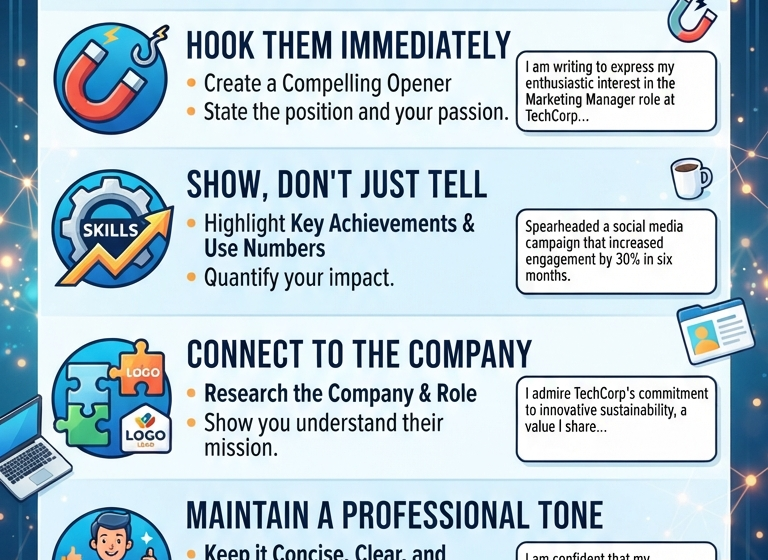
Recruiters read dozens of cover letters that all start the same way: “I am writing to apply for the position of…” Skip this. Open with something that shows genuine interest or connects you to the company immediately.
Weak opening: “I am writing to apply for the Marketing Coordinator position.”
Stronger opening: “When I saw that [Company] was looking for a Marketing Coordinator to lead its social campaigns, it felt like a perfect match for the work I’ve spent the last three years doing.”
A strong first line tells the reader you’re not sending a generic, copy-pasted letter to fifty companies at once.
Mention the Role and Where You Found It
Right after your hook, clearly state the position you’re applying for and, if relevant, where you saw the listing or who referred you. This helps whoever is sorting applications route yours correctly.
2. Connect Your Experience Directly to the Job
This is the core of your cover letter — and where most people go wrong by simply repeating their resume in paragraph form. Instead, pick two or three specific accomplishments that map directly onto what the job description asks for.
For example, if the posting emphasizes “managing cross-functional projects,” don’t just say you have project management experience. Say something like:
“In my current role, I coordinated a six-person cross-functional team across marketing, design, and engineering to launch a product update two weeks ahead of schedule.”
This shows, rather than tells, that you can do exactly what they’re hiring for.
Use the Job Description as Your Outline
Before writing, highlight the three or four most important requirements in the job posting. Structure your middle paragraphs around matching your experience to each of those, in the employer’s own language where possible.
3. Show You Understand the Company
Generic cover letters rarely mention anything specific about the company itself. Spend ten minutes researching before you write — check their website, recent news, or their mission statement — and reference something specific.
This could be:
- A product or project they’ve recently launched
- Their company values or mission, if it genuinely resonates with you
- Something about their industry position or growth that excites you
Even one sentence showing you did your homework sets you apart from candidates who clearly didn’t.
4. Keep It Short and Easy to Read
A cover letter should be three to four short paragraphs — roughly 250 to 350 words. Hiring managers are busy, and a cover letter that goes on for a full page often goes unread.
Formatting tips:
- Use short paragraphs, not dense blocks of text
- Avoid repeating your resume word-for-word
- Skip generic phrases like “team player” or “hard worker” without backing them up with specifics
- Write in a natural, professional tone — not overly formal or stiff
5. End With a Confident, Clear Closing
Your closing paragraph should reaffirm your interest and make it easy for the reader to take the next step.
Example closing: “I’d welcome the chance to discuss how my experience in [specific skill] could contribute to [Company]’s goals. Thank you for considering my application — I look forward to hearing from you.”
Avoid closings that sound passive or unsure, like “I hope you’ll consider me.” Confidence, without arrogance, reads much better.
6. Proofread and Personalize Every Version
Never send the exact same cover letter to multiple companies. At minimum, always update:
- The company name and role title
- The specific accomplishments you highlight
- Any references to the company’s mission or projects
Then read it out loud once before sending — this catches awkward phrasing and typos that silent reading often misses.
Frequently Asked Questions
Is a cover letter still necessary in 2026? Yes, in most industries a cover letter is still expected, especially for roles that involve communication, client interaction, or leadership. Some tech and creative roles are more flexible, but including one rarely hurts your chances.
How long should a cover letter be? Aim for three to four paragraphs, around 250-350 words. Long enough to make your case, short enough that it actually gets read in full.
Should a cover letter repeat what’s on my resume? No — it should complement your resume by adding context and specific stories behind a few key achievements, not restate your full work history.
What if I don’t have direct experience for the role? Focus on transferable skills and relevant projects, even from unrelated fields, and clearly explain how they apply to this new role.
Do I need a different cover letter for every job? Yes, at least in terms of personalization. You can reuse a strong structure, but the specific details should always match the job and company you’re applying to.